
Nashville Chapter Key Take Aways!
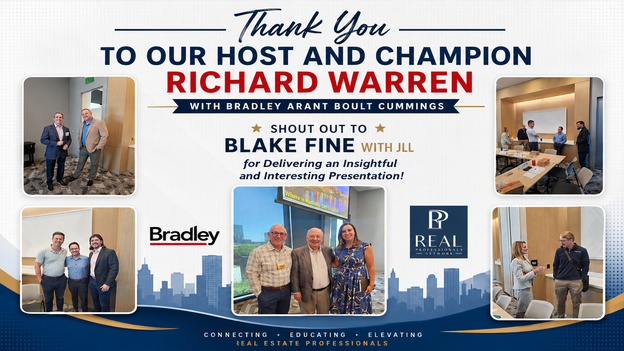
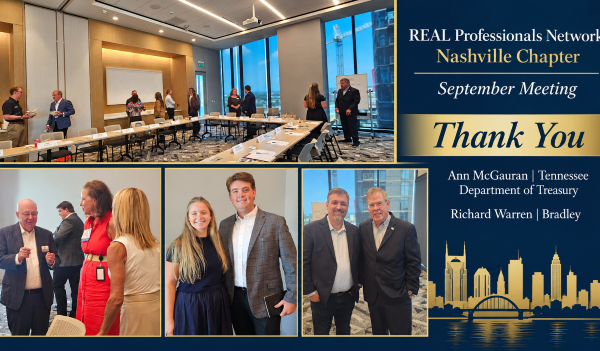
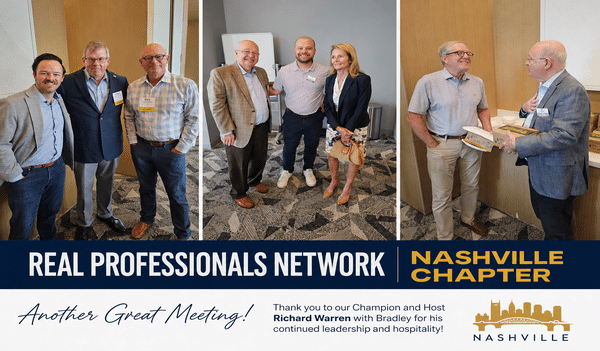
Richard Warren (Bradley Arant): Richard discussed how Nashville has experienced repeated real estate cycles of overbuilding and correction, noting that while sectors like downtown high-rise apartments are currently oversupplied with heavy concessions being offered, this cycle differs because lenders have maintained more disciplined underwriting and are avoiding widespread foreclosures. He explained that many troubled projects are being resolved quietly through workouts, recapitalizations, and new equity partnerships rather than public defaults, with sponsors relying on strong balance sheets and long-term confidence that supply and demand will eventually rebalance. He also emphasized continued long-term optimism for Nashville’s growth with Starbucks coming to Nashville. This is showing people still want to come to Nashville.
Chris Green (Terracon): Chris shared that his firm is beginning to see banks revisit and relearn foreclosure and workout processes as concerns increase about projects that may not be successfully refinanced or renewed, creating more due diligence opportunities within the market. He noted that Nashville continues to stand out nationally, especially compared to challenges being experienced in other markets like California, with major companies and investments continuing to relocate to the city. Chris also emphasized that Nashville’s continued investment in sports, entertainment venues, infrastructure, and public spaces has become a national example, with discussions at conferences highlighting how the city successfully uses public spaces to encourage connection and growth.
Gregg Riddle (W.E. O’Neil Construction Co.): Gregg shared that the construction market remains robust, particularly in suburban areas like Franklin, where significant development is occurring across multifamily, retail, hospitality, and education projects despite some slowdown in multifamily caused by interest rates and rental concessions. He explained that many multifamily projects that had previously been paused are now moving forward because developers no longer expect interest rates to improve, while retail and hospitality development are especially strong in the Nashville market, with major projects underway in Franklin, Thompson’s Station, and at the University of Tennessee. Gregg also highlighted continued demand for hotels, schools and educational facilities due to population growth.
Hunter Johnson (Terracon): Hunter shared that Nashville is still seeing strong investment activity, particularly from the perspective of firms involved in the later stages of due diligence and environmental review for development projects. He explained that clients are being much more cautious and deliberate about understanding remediation costs, contamination risks, and liability protections before moving forward with investments, ensuring they fully understand the financial impact of environmental issues tied to a property. Hunter emphasized that while growth and development activity continue steadily, decision-making has become far more careful and measured.
Jeffrey Coats (JS Coats Capital, LLC): Jeffrey shared that lenders are still actively financing deals, including more aggressive structures, but underwriting standards and risk sensitivity are tightening due to inflation concerns and broader geopolitical uncertainty. He highlighted a significant hospitality refinancing in Washington State where multiple banks participated in a large non-recourse loan for a sponsor with a very strong balance sheet and development history, demonstrating that lenders are still willing to take calculated risks for experienced borrowers. He also discussed continued lending activity across retail and life company loans, noting that while rates have increased and smaller loans remain expensive to refinance, strong sponsors and conservative leverage are still helping deals move forward successfully.
Katie O’Neil (Terracon): Katie shared that while the market feels slower than in previous years, development work is still consistently happening across the region. She noted that multifamily activity is beginning to increase again, although it has not returned to prior levels, while industrial development continues to show strong and steady demand. Katie also emphasized that much of the current growth is occurring outside of Davidson County, particularly in Rutherford County, where development activity remains very active.
Kelly Cochran (State of Tennessee Real Assets Management (STREAM): Kelly explained that government office leasing activity is currently slower due to the upcoming election cycle and anticipated leadership changes within General Services as many directors prepare for retirement. She shared that some agencies are focused on conserving resources and limiting rent expenses because of changing federal reimbursement structures, while other fully state-funded agencies are aggressively pursuing new space and expecting projects to move quickly. Kelly also emphasized the challenge of managing rising construction costs and lease rates, noting that newer leases have increased from the $15–$18 range into the mid-$30 range, creating pressure to keep future leases and escalations as reasonable as possible through the end of the year.
Dane Brunett (First Citizens National Bank): Dane shared that his bank is still seeing strong deal activity across most asset classes, although hospitality and multifamily have slowed compared to previous years, while retail, residential construction, and land development remain active. He emphasized that lenders are currently focused on cash flow, liquidity, and conservative underwriting, but are still actively pursuing deals that make financial sense. He also noted significant residential development activity in areas like Wilson County and Gallatin, while observing that homes priced between $600,000 and $2 million are sitting on the market longer than luxury homes priced above $3 million, leading some builders to shift toward larger, high-end homes. He says price points are making a difference.
Gary O’Brien (LaBella Associates ): Gary shared that development activity in Metro Nashville has slowed, largely because of land prices, while significant growth and project activity are occurring in surrounding second- and third-ring markets such as Manchester, Tullahoma, and Chattanooga. He explained that his firm is seeing strong demand across industrial, warehousing, distribution, manufacturing, retail, senior living, and single-family residential projects, both regionally and nationally, with projects extending into states like North Carolina, Missouri, and Mississippi. Gary noted that retail activity is beginning to strengthen again, while multifamily remains slower in Nashville, and industrial development continues to be the strongest sector they are currently seeing.
Joe Cavicchi (Sanders Carter): Joe explained that as a newer development firm in Nashville, success today requires much more than submitting an LOI and earnest money, as sellers, brokers, lenders, and equity partners are placing greater emphasis on track record, partnerships, financing, and having a realistic plan to execute projects. Joe shared that many development sites now come with fatigue from failed transactions, but he believes the increased scrutiny is positive because it narrows the field to groups that are prepared, transparent, and capable of actually delivering projects. He also noted that developers are shifting away from relying on projected rent growth and traditional return metrics, while sellers are slowly becoming more realistic on land pricing and increasingly willing to structure joint venture opportunities to help projects move forward.
Mia Keller (The Pizzuti Companies): Mia discussed the challenges developers are facing in multifamily development, particularly with equity, declining rents, stabilized assets selling below replacement cost, and sellers still holding high expectations despite slowed development activity. She shared that industrial development remains strong, but has become complex and time-consuming with zoning, infrastructure, and municipal coordination. She also highlighted how areas like 12 South and Wedgewood-Houston have transformed into high-rent retail and hospitality destinations driven by tourism and branding, while expressing concern about the impact on local businesses. Mia also mentioned her involvement with the nonprofit, Water Walkers (https://waterwalkerstn.org/) that supports children in Edgehill public housing.
Thomas Freeland (Freeland CRE): Thomas said consumer spending remains strong in tourism and hospitality markets, while sellers in secondary and tertiary markets are becoming more willing to lower pricing compared to prior years. He noted strong demand for flex and small industrial space, with projects leasing quickly even before construction is complete, while many industrial users are relocating outside Nashville because of higher rents and traffic. He also said their company self-finances projects with moderate debt, has ongoing office lease-up activity, and is actively developing projects in Columbia and Clarksville while navigating infrastructure and sewer capacity challenges.
Edward Herbert (CCIM): Edward brought a different perspective and reflected on being 86 years old and in the business for 44 years, explaining how local people and relationships built much of Nashville through construction, lending, and development long before outside investors arrived. He described how Nashville’s early growth was shaped by a small group of local banks and developers who made decisions based on instinct, opportunity, and belief in the city rather than modern financial concepts like cap rates and analytics. He also shared how dramatically Nashville has changed from a city few people talked about into one of the top places to live, while expressing pride in knowing the people, businesses, and history behind areas like 12 South and downtown Nashville.






Recent Comments