
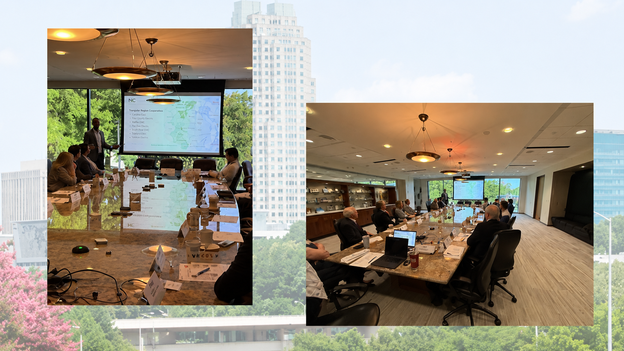
Raleigh Chapter Key Take Aways!
Economic Overview
The Triangle Remains One of the Nation’s Strongest Growth Markets
- North Carolina ranked #3 nationally for population growth at 1.3%.
- Raleigh was the fastest-growing major market in the U.S. from 2024-2025 with 2.4% population growth, outperforming Austin, Charlotte, and Nashville.
- Since 2020, Raleigh’s job growth has been more than three times the national average.
Economic Headwinds Exist
- High energy and transportation costs continue to pressure businesses.
- Federal spending cuts in education and research have created some local hiring freezes and reduced office demand.
- Consumer confidence remains weak.
- Manufacturing remains a bright spot, especially pharmaceuticals and life sciences. Major investments continue from companies including Novo Nordisk, Fujifilm, AbbVie, and Amgen.
Multifamily Market
Demand Remains Strong
- The Triangle now contains more than 203,600 apartment units across approximately 1,450 properties.
- Apartment demand remains above historical averages, although absorption has moderated over the past two quarters.
Supply Is Finally Slowing
- Multifamily deliveries remain elevated but are beginning to decline.
- The construction pipeline has fallen 51% from its peak, dropping from approximately 21,600 units under construction to 10,500 units.
Vacancy Remains Elevated
- Raleigh vacancy: 10.6%
- Durham vacancy: 11.5%
- U.S. average: 8.5%
Class A Properties Face the Most Pressure
- Vacancy rates for 4- and 5-star communities remain significantly higher than lower-tier assets.
- Luxury product continues to absorb the majority of recent oversupply.
Rent Growth Has Been Negative
- Annual apartment rent growth has been negative for three consecutive years.
- 2023: -1.3%
- 2024: -1.4%
- 2025: -1.5%
- 2026 forecast: -0.2% before modest recovery in 2027-2028.
Concessions Remain Aggressive
- Concession rates in both Raleigh and Durham remain near record highs as landlords compete for tenants.
Investment Market Showing Signs of Recovery
- Average market pricing has recovered to approximately $231,730 per unit, though actual transaction pricing remains closer to $205,017 per unit.
- Transaction activity remains below peak 2021-2022 levels but has improved from 2024 lows.
Multifamily Outlook
- Vacancy likely rises slightly as remaining projects deliver.
- Declining construction activity should help the market rebalance beginning in 2027.
- Rent growth expected to return to positive territory over the next several years.
Industrial Market
Demand Has Slowed but Remains Positive
- Industrial demand remains above long-term historical averages but has cooled compared to the pandemic-era boom.
Vacancy Continues Rising
- Triangle industrial vacancy has risen to approximately 7.8%, nearly matching the national average of 7.7%.
By Market
- Raleigh Industrial Vacancy: 7.3%
- Durham Industrial Vacancy: 9.2%
- Charlotte Industrial Vacancy: 10.1% (highest among peer markets)
Mid-Sized Buildings Are Most Challenged
- Properties between 100,000 and 500,000 SF have the highest vacancy rate at 12.2%.
- Large-box properties over 500,000 SF remain relatively healthy at just 1.9% vacancy.
Development Pipeline Remains Significant
- Approximately 51% of the industrial construction pipeline remains available.
- Chatham County, Southeast Wake County, Franklin County, and South Durham are seeing the largest concentrations of new industrial development.
Data Centers Becoming a New Discussion Point
Several proposed projects include:
- Microsoft data center in Person County.
- PointOne data center in Lee County.
However, multiple jurisdictions have implemented moratoriums or restrictions due to community concerns, including Chatham County, Orange County, Apex, and Wendell.
Industrial Rents Still Growing
- Raleigh average industrial rent: $12.83/SF
- Durham average industrial rent: $11.72/SF
- Both exceed the national average of $12.15/SF or are near it.
Rent Growth Is Slowing
- Raleigh industrial rent growth: 2.8%
- Durham industrial rent growth: 3.0%
- Triangle-wide growth continues to decelerate but remains positive.
Industrial Investment Market Remains Strong
- Industrial pricing continues to increase despite higher vacancies.
- Average pricing reached approximately $153/SF, while actual transaction pricing is approximately $146/SF.
What CRE Professionals Should Watch
Positive Trends
✅ Raleigh remains one of the fastest-growing markets in America.
✅ Population and job growth continue to support long-term real estate demand.
✅ Life sciences and advanced manufacturing investments remain major economic drivers.
✅ Multifamily construction is slowing, setting up a healthier balance in coming years.
✅ Industrial rents continue to grow and investment sales remain active.
Challenges
⚠️ Multifamily vacancies remain elevated and concessions are widespread.
⚠️ Apartment rent growth remains negative.
⚠️ Industrial vacancies continue rising due to new supply.
⚠️ Federal spending cuts and economic uncertainty are impacting office demand and business expansion decisions.
Bottom Line
The Triangle remains one of the strongest long-term growth markets in the country, driven by population growth, job creation, life sciences, and manufacturing investment. However, both multifamily and industrial sectors are working through a significant supply wave that is temporarily increasing vacancies and moderating rent growth. The market’s long-term fundamentals remain very strong, but owners and investors should expect a more competitive leasing environment through at least 2026 and into 2027.





Recent Comments