

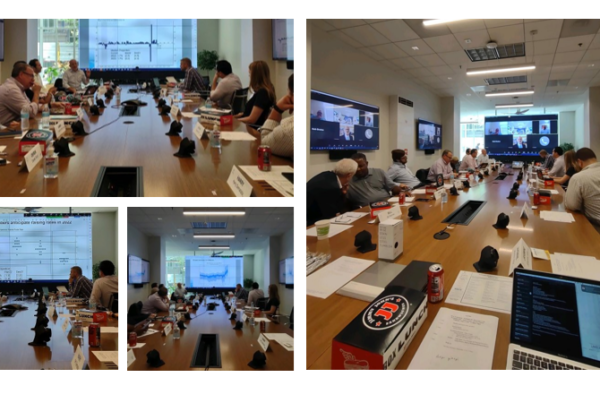
Washington DC Chapter June Meeting!
Economic & Demographic Outlook
- Washington, DC faces significant economic headwinds
- The region is experiencing one of the most challenging employment environments in the country.
- The DC region lost approximately 52,900 federal jobs and more than 103,900 total jobs over the past year.
- CoStar and Oxford Economics are forecasting negative job growth in 2025 and 2026, making DC an outlier compared to most major U.S. metros.
- Policy uncertainty remains a major concern
Key risks impacting decision-making include:
- Federal workforce reductions
- Agency relocations
- Immigration policy changes
- Trade policy and tariffs
- Inflationary pressures
- Geopolitical uncertainty
- Growth will shift toward outer suburban markets
Despite broader regional weakness:
- Loudoun County is projected to lead the region with approximately 12,000 new jobs between 2026-2030.
- Prince William County follows with approximately 9,000 new jobs.
- These areas continue benefiting from data centers, technology investment, and population migration trends.
- Population growth remains a bright spot
- While employment growth is slowing, population growth is still expected to outpace the national average.
- This provides an important long-term support mechanism for housing and retail demand.
Multifamily Market
- Multifamily fundamentals are softening but remain relatively stable
- Apartment demand has normalized following exceptionally strong post-pandemic years.
- Absorption declined in 2025 and is expected to weaken further in 2026.
- Construction pipeline is shrinking rapidly
- Multifamily units under construction have fallen significantly below historic averages.
- New starts have slowed considerably due to:
- Higher interest rates
- Construction costs
- Financing challenges
- This reduction in future supply could eventually support stronger fundamentals.
- Vacancy trends are improving
One of the more positive findings:
- Vacancy rates have begun declining slightly.
- CoStar forecasts vacancy rates will continue improving through 2027-2028 as new deliveries slow.
- Rent growth is under pressure
- Multifamily rents are currently experiencing flat to negative growth.
- Early 2026 annual rent growth was approximately -1%.
- Monthly rent growth has been weaker than historic seasonal patterns.
- Federal workforce reductions create additional apartment risk
Unlike most U.S. markets:
- Washington’s apartment sector is directly tied to federal employment.
- Government layoffs and contractor reductions could further impact renter demand.
Office Market
- The office market has not yet found its bottom
Key themes highlighted:
- Demand remains weak.
- Return-to-office mandates have helped somewhat, but not enough to materially improve fundamentals.
- The market remains highly dependent on federal employment and contractor activity.
- Little to no rent growth expected
- Office rents are expected to remain largely flat.
- Vacancy rates are expected to remain elevated, although new supply is declining.
- The lack of new construction may eventually help stabilize fundamentals.
- Winners and losers are becoming more apparent
The office market continues to bifurcate:
- Trophy and highly amenitized assets are outperforming.
- Older commodity office properties continue to struggle.
- Demolitions and conversions are becoming more common nationally and are likely to increase in DC.
Industrial Market (Summary)
- Industrial remains the strongest major property type
Although only summarized in the presentation:
- Industrial fundamentals remain healthy.
- Demand is moderating from record highs but remains positive.
- Data center development continues to be a major economic driver, particularly in Northern Virginia.
Retail Market (Summary)
- Retail continues outperforming expectations
- Retail remains one of the healthiest CRE sectors nationally.
- Limited new supply continues supporting occupancy and rent growth.
- Population growth and suburban migration patterns are helping neighborhood retail perform well.
Overall CRE Outlook for Washington DC
Positive Signals
✔ Population growth remains above the national average
✔ Multifamily construction pipeline is shrinking, helping future fundamentals
✔ Vacancy in multifamily is beginning to improve
✔ Loudoun and Prince William Counties continue to generate jobs
✔ Industrial and retail sectors remain relatively healthy
Challenges
⚠ Federal employment losses are creating significant economic drag
⚠ Regional job growth is expected to trail the nation through 2026
⚠ Multifamily rents are flat to declining
⚠ Office demand remains weak and has not fully stabilized
⚠ Ongoing policy and government uncertainty is impacting investment decisions
Bottom Line
The Washington DC market is entering a period of adjustment driven largely by federal workforce reductions and slower economic growth. While the office sector continues to face significant challenges, multifamily fundamentals appear to be stabilizing due to a sharp decline in new construction, and long-term population growth remains a positive indicator. The strongest opportunities appear to be in growth corridors such as Loudoun and Prince William Counties, as well as sectors tied to data centers, industrial development, and necessity-based retail.








Recent Comments