
Charlotte Chapter June Meeting!
CRE Market Pulse Index | September 2025 – May 2026
- Market Sentiment Has Improved Significantly
- The commercial real estate market has moved from widespread pessimism toward cautious optimism.
- In September–October 2025, 48% of respondents described the market as “Dead” or “Slow.”
- By January 2026, 70% viewed the market as “Active” or “Hot.”
- By May 2026, 58.4% characterized the market as either “Stabilizing” or “Accelerating,” signaling a measured recovery rather than a rapid rebound.
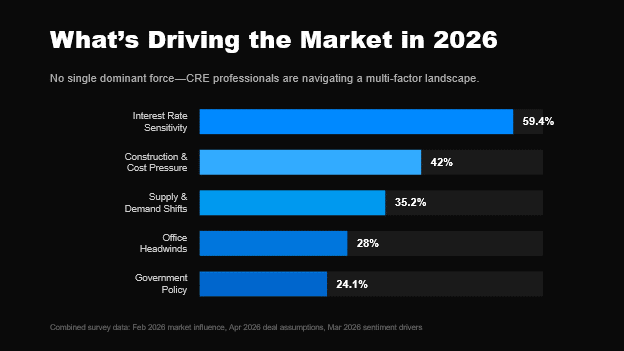
- Interest Rates Remain the Dominant Market Driver
- 59.4% of respondents cited interest rate sensitivity as the most influential factor affecting the market.
- Financing structures and borrowing costs continue to play a major role in investment and development decisions.
- Capital is available, but underwriting standards remain disciplined.
- Construction Costs Continue to Challenge Development
- 42% identified construction costs and development expenses as major market influences.
- The biggest challenge is not demand for projects but the ability to make projects financially feasible.
- Entitlement timelines and rising development costs remain significant obstacles.
- Investor Sentiment Became More Defensive
- While activity remains strong, investors have shifted toward a more cautious posture.
- In late 2025 and early 2026, 44% of respondents were bullish or optimistic.
- By March 2026, 67.8% described themselves as bearish or cautious.
- Investors are focusing on downside protection, quality assets, and disciplined execution.
- Uncertainty Is Reshaping Risk Assessment
Several factors are causing market participants to reassess risk:
- Geopolitical tensions and global economic uncertainty.
- Capital market volatility.
- More conservative lending practices.
- Continued bid-ask spread challenges between buyers and sellers.
- Longer decision-making timelines for investments and developments.
- Capital Is Still Being Deployed
- More than 90% of respondents reported actively deploying capital.
- Investors are pursuing:
- Opportunistic acquisitions
- Repriced assets
- High-conviction investments
- Few respondents indicated they were aggressively expanding or completely sidelined.
- Industrial, Retail, and Multifamily Lead Investment Preferences
Respondents ranked property sectors with the strongest risk-adjusted upside as:
- Industrial
- Retail
- Multifamily
- Office (trailing significantly behind other sectors)
Industrial continues benefiting from logistics and supply chain demand, while retail has proven more resilient than many expected. Multifamily remains supported by long-term housing demand fundamentals.
- The Bid-Ask Gap Remains a Barrier
- 31.7% of respondents believe pricing remains disconnected between buyers and sellers.
- Only 30.6% believe asset values are appropriately aligned.
- Price discovery continues to be one of the primary constraints on transaction volume.
Strategic Outlook
What CRE Professionals Should Watch
- Continued movement in interest rates and capital markets.
- Construction costs and project feasibility.
- Pricing alignment between buyers and sellers.
- Sector-specific opportunities rather than broad market appreciation.
- The widening performance gap between high-quality assets and everything else.
Bottom Line
The commercial real estate market is no longer waiting for recovery—it is actively moving forward. However, success is increasingly dependent on disciplined underwriting, strategic capital deployment, operational execution, and selecting the right asset classes and markets. The era of broad-based appreciation has given way to a market where execution, pricing discipline, and market selection will determine the winners.








Recent Comments