
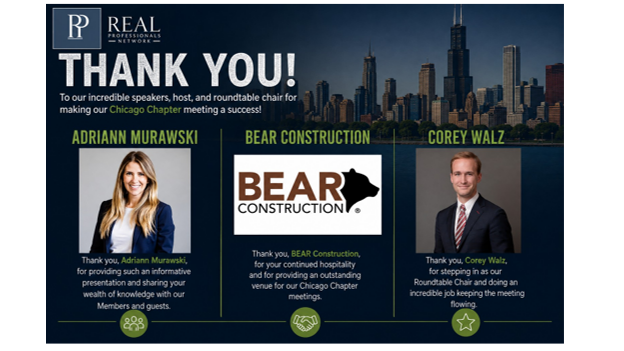
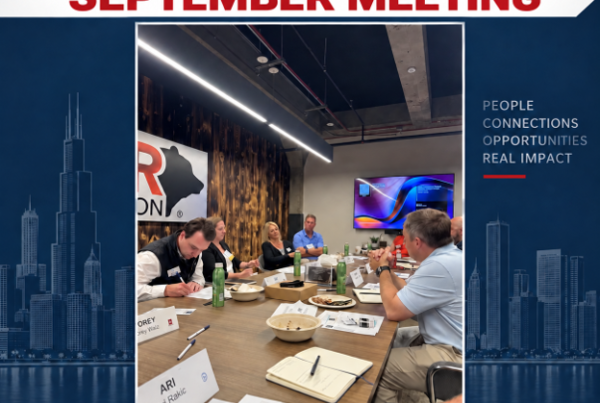
Chicago August Meeting Key Take Aways!
Adriann Murawski, Sparrow Public Affairs / The Prairie Consulting Group
Adriann highlighted several political and legislative issues likely to impact the Chicago real estate market over the next year. Key discussion points included the 2027 Chicago mayoral race, City Council elections, and voter participation trends. She noted that relatively low voter turnout means a small percentage of residents often have a significant impact on election outcomes and future policy direction.
She emphasized that having the most money doesn’t always win the election. As of late July, there are 89 candidates. She recommended keeping an eye out on the following wards: 1, 6, 7, 12, 13, 25, 30, 33, 35, 37, 44, 45, 48, 50.
On the legislative side, Adriann discussed ongoing debates around city budgeting, debt-check processes, housing policy, and data center regulation. She noted that city leaders are focused on increasing oversight and reporting requirements for data centers, particularly regarding energy, water usage, and emissions. While acknowledging the economic importance of data centers, policymakers are seeking greater accountability regarding their impact on city infrastructure.
Housing-related legislation remains a major topic of discussion in Chicago, with proposals focused on tenant protections and displacement concerns. These policies continue to generate debate among property owners, developers, and tenant advocacy groups regarding their potential impact on housing availability, development activity, and rental costs.
Eli Mills, CoStar Group
Eli is closely monitoring the United Center district redevelopment, which includes a new amphitheater and surrounding mixed-use development. He expects significant office growth in the area and noted the growing trend of professional sports ownership groups investing not only in stadiums and arenas but also in large-scale surrounding real estate developments. He noted the difference in approaches of the United Center vs. Soldier Field, and will be keeping an eye on them.
Brian Lee, Phoenix Builders
Brian discussed continued interest in multifamily developments throughout Chicago and the suburbs, although some projects are facing financing challenges. He also noted increasing activity around health and wellness-focused campuses and continued demand in the self-storage sector, which remains highly occupied at 92%. He’ll be looking for investment partners in Chicago, the suburbs, and Florida.
Eric Steffensen, Easton Harbor LLC
Eric shared concerns about rising construction costs, particularly labor and electrical expenses. He noted that competition from data center projects is increasing demand for skilled trades, contributing to higher labor costs across the construction industry. Tariffs continue to add pressure to project budgets, while developers remain focused on securing investment capital for new projects.
Adrian Brizuela, CoStar
Adrian reported that multifamily demand remains healthy but is moderating compared to the exceptionally strong growth experienced from 2023 through 2025. Unit numbers are looking to decrease in 2027 and 2028. Vacancy rates remain stable due to limited supply. He also highlighted positive trends in industrial real estate, driven by logistics activity, along with signs of renewed momentum in retail through adaptive reuse and smaller, more efficient store footprints.
Chris Perrotta, BEAR Construction Company
Chris noted that BEAR is currently seeing strong activity in downtown tenant improvement projects, particularly office buildouts. While proposal and bidding activity remains high, project execution continues to be impacted by labor shortages, material procurement delays, and ongoing tariff-related pricing pressures. Clients are also demanding increasingly compressed project schedules, creating additional challenges for contractors and subcontractors.
Corey Walz, Walz Kraft Capital Partners
Corey identified medical office properties as one of the strongest-performing sectors in commercial real estate, a field that’s been growing since 2015. He also discussed concerns surrounding energy demand and infrastructure as industries such as healthcare and data centers continue to require significant electrical capacity and backup power resources. The fear of data centers and what they will do to communities is high, but he feels it may just be a small trend in the grand scheme of things.
Michael Derouin, Fitzgerald Associates Architects
Michael reminded attendees of upcoming Illinois building, energy, and mechanical code changes scheduled to take effect November 1st, 2026, and reminded the group to get their permits now. He noted that regulatory and political leadership decisions can significantly influence development activity and investment confidence within the market, hoping a growth mindset mayor will help open up some more options.
Michael Semenzin, RACER Design Studio
In observation of the post pandemic “slow office recovery” idea, Michael suggested the market has already settled into a new long-term workplace model rather than returning to pre-pandemic norms. He also noted growing interest in experiential retail and lifestyle-oriented developments that create destinations and community engagement opportunities, especially with the fear that AI can take over many jobs. These new community spaces may very well be the next “big thing”. He reiterated that project timelines can be frustrating.
Scott Borstein, Neal & Leroy
Scott reported that land use and zoning activity remains relatively slow, with fewer new development inquiries than in previous years. He cited broader economic uncertainty and ongoing fiscal challenges facing local governments, such as Chiago, as factors contributing to slower market activity like the pension crisis. He noted that he’ll be interested to see how AI impacts land use and zoning, since those are such a hands on practice.
Joe Guerrero, Global Water Technology
Joe discussed increased industry focus on water management, public health, and infrastructure monitoring, especially in response to recent waterborne pathogen concerns. The outbreak hit heavily in NYC. They have advanced testing, and Chicago is trying to replicate that. He noted that data center growth is driving investments in more advanced and sustainable water management technologies, as Chicago attempts to be more proactive to mitigate outbreaks like this.
Patrick Clancy, Dinsmore & Shohl
Patrick shared that multifamily and industrial development projects continue to face headwinds related to financing, capital availability, approvals, and project costs. While development interest remains, many projects are taking longer to advance due to increased risk sensitivity, tighter financial conditions, and overall avoidable issues as well.
Overall Themes
- Political decisions and upcoming elections are expected to significantly influence commercial real estate, housing, development, and infrastructure investment in Chicago.
- Data centers remain a major growth driver but continue to raise questions around energy usage, infrastructure capacity, and regulatory oversight.
- Labor shortages, rising construction costs, tariffs, and capital constraints continue to challenge development and construction activity.
- Multifamily demand remains stable, while industrial, logistics, medical office, and adaptive reuse projects continue to show positive momentum.





Recent Comments