
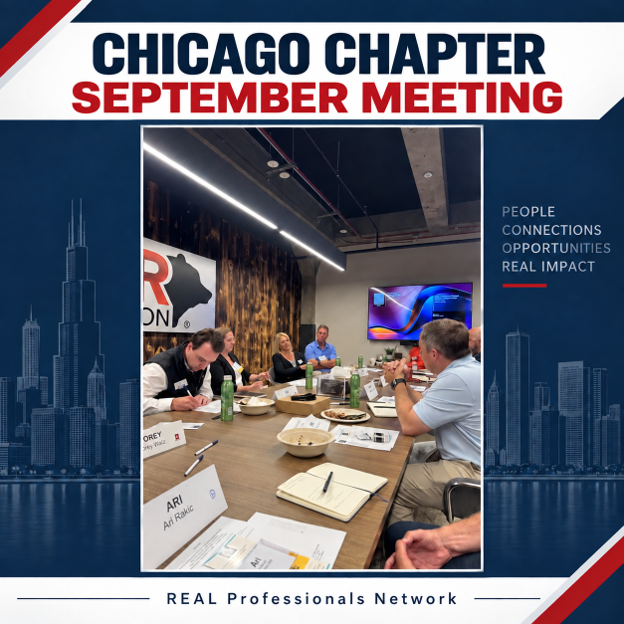
Chicago Chapter September Meeting!
Lauren Zangl, Partner Engineering and Science, Inc.
Lauren opened the meeting and welcomed attendees to a discussion on the latest trends shaping real estate, development, and construction. Topics ranged from multifamily growth and office conversions to AI, modular construction, environmental health, and the challenges facing aging building infrastructure.
Adrian Brizuela, CoStar Group
Adrian began by highlighting several real estate market trends. In retail, the pipeline remains top-heavy, with the five largest projects accounting for roughly 80%. Most new developments are trending toward smaller formats of 20,000 square feet or less. He noted that office vacancies remain elevated, although there is limited contiguous space available above 30,000 square feet, and tenants continue to seek more efficient footprints. Adrian also shared that urban rent growth is significantly outpacing suburban markets, at approximately 8% compared to 2%, but it’s not a major cause for concern.
Alissa Adler, Transwestern
Since joining Transwestern, Alissa’s perspective has expanded beyond Chicago as she now works across markets throughout the Midwest, where she’s seen an increase in industrial activity. In the office market, Alissa discussed the growing interest in office-to-residential conversions, including projects that partially convert office space to multifamily use. East Loop faces some of the greatest challenges, as owners and investors grapple with the high costs of acquiring and operating office towers. Attracting equity to Chicago remains difficult, as many investors view the market broadly even though performance and opportunities vary significantly from building to building.
Chris Perrotta, BEAR Construction Company
Chris shifted the conversation to the rapid evolution of AI, particularly with recent releases from Claude and ChatGPT. The group discussed how AI is progressing from a tool that simply assists with tasks to one that can increasingly perform portions of a job autonomously. A key question raised was what this means for younger professionals entering the industry. Rather than focusing on replacing people, the discussion centered on the importance of learning how to effectively manage and utilize AI tools to remain productive and valuable as technology advances.
Corey Walz, Walz Kraft Capital Partners
Corey shared that he is rolling out a brokerage firm focused on investment sales and has seen increased activity across the market, with more owners becoming willing to sell and dealmakers finding creative ways to get transactions across the finish line. He noted that some of the previous market logjam appears to be easing, potentially driven in part by an aging doctor population and the ongoing consolidation of medical practices. He also shared an interesting conversation with a local alderman about increasing housing stock through adaptive reuse rather than expanding building footprints. One idea being explored is converting underutilized retail space into residential units, allowing property owners to generate higher rents while reducing excess retail square footage.
Eli Mills, CoStar Group
Eli discussed the strong appetite for multifamily development in Chicago, particularly for projects with more than 100 units. He noted that the market has seen several nine-figure multifamily sales this year and is currently on a record pace for transaction volume, with 2026 positioned to potentially surpass the $6.2 billion recorded in 2022. Eli also highlighted potential development opportunities tied to the future ownership of the White Sox, suggesting it is an area worth watching. He concluded by offering himself as a resource for reliable multifamily market data and insights.
Erik Steffensen, Easton Harbor LLC
Erik shared that he is seeing an increase in conversations around potential development opportunities and transactions nationally, including Chicago. He noted growing interest in modular construction, particularly in the residential sector, with discussions centered on how prefabricated building methods can help tackle challenging projects, such as resort homes in remote or difficult-to-access locations like on the side of a mountain. As an example of continued investor interest in specialized asset classes, Erik highlighted the recent sale of a data center for $750 million.
Paul Larkin, BEAR Construction Company
Downtown recovery is still coming back slowly, with Paul noting several encouraging signs of activity, including new developments such as 79 W. Monroe and other revitalization efforts – his team remains busy. While many companies are reducing their office footprints by 50% to 60%, larger projects are still moving forward, including a planned 70,000-square-foot office buildout. He expressed concern about Chicago’s aging building stock, emphasizing that many downtown properties require major infrastructure and capital improvements. Although owners are often hesitant to make those investments, the need to modernize older buildings could create significant opportunities for the construction industry.
Alicia Frame, Mavrek, Inc.
As both a general contractor and developer focused primarily on multifamily projects, many of the market trends discussed throughout the meeting resonated with Alicia’s own experiences. She’s excited about the growth of her team and highlighted several major projects currently underway, including the conversion of 65 E. Wacker Place. While welcoming tenants into a property for the first time, Alicia noted that the experience has been both rewarding and challenging, offering new lessons about the realities of adaptive reuse and redevelopment. She also discussed the groundbreaking of 1000 W. Jackson, describing the milestone as both exciting and intimidating as the project moves into its next phase.
Mark Mockus, Fusion
Mark shared that after 40 years as an architect, he now focuses on national business development. His firm operates in 40 states, is licensed in all 50, and was formed two years ago through the merger of four firms across seven offices. Restaurant and healthcare projects continue to be major areas of focus, and he agreed that multifamily development remains strong across the country. Mark also reflected on his work at the Old Post Office, joking that much of the building had to be measured by hand because existing information was often inaccurate. He added that his team is closely tracking multifamily trends nationwide as market activity continues to grow.
Mike Ebel, Partner Engineering & Science
Mike shared a glimpse into the world of health and safety, where his work focuses on understanding exposures to things like dust, chemicals, fragrances, and other airborne contaminants and determining their impact on the people around them. He emphasized a practical, common-sense approach to solving these issues while helping organizations navigate regulations from agencies like OSHA and the EPA. Mike also reflected on his experience serving as a consultant following 9/11, discussing the long-term health effects that can emerge years after exposure and the importance of understanding the true causes of occupational illnesses.
Mike Semenzin, RACER Design Studio
Mike’s firm is seeing an uptick in projects and requests for small retail projects. The conversation turned to AI and its impact on the future of architecture, especially as the next generation enters the workforce. He also touched on broader industry concerns, referencing a recent building failure in New York City and the consequences of cutting corners in design and construction. The discussion expanded to climate change and its potential long-term effects, using Texas as an example of how larger economic and social trends can influence real estate demand.




Recent Comments