
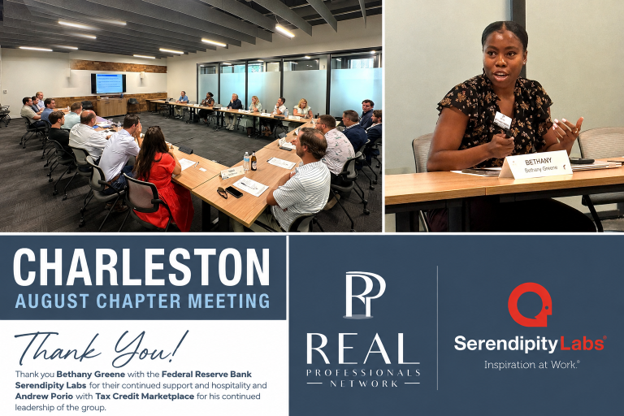
Charleston Chapter August Meeting!
- The overall economy remains solid. Economic activity continues to hold up despite volatility in some GDP components, supported by resilient consumer spending and strong AI-related investment.
- Consumer spending remains a source of strength—but the story differs significantly by income. Higher-income households are substantially outpacing middle- and lower-income households in discretionary categories such as travel and clothing, creating an increasingly “K-shaped” spending environment.
- Household finances are relatively healthy in aggregate. Gains in household net worth have helped support spending, while household balance sheets overall remain in good shape. However, the strength shown in aggregate data can mask differences among households.
- AI investment is an important economic growth engine. Investment in information-processing equipment and data-center construction has been particularly strong. The presentation also notes that 2026 S&P 500 gains have been driven solely by AI and energy.
- Inflation remains above the Federal Reserve’s 2% target. Energy prices have contributed to the recent increase, while producer prices are also rising—particularly in the earlier stages of production.
- The labor market is stable but has clearly cooled. Hiring and labor-force growth have slowed, and recent U.S. job gains are concentrated in relatively few industries. Employment growth has also been stronger among larger companies.
- South Carolina is showing comparatively encouraging labor-market trends. Job growth in the state is more broadly distributed across industries, and while national labor supply has flattened, South Carolina’s labor-force trend has remained more positive.
- The current labor environment can be characterized as “low hire, low fire.” Employers are generally not adding workers aggressively, but they also aren’t engaging in widespread layoffs. Recent college graduates are experiencing an especially challenging employment market.
- Interest rates remain restrictive. The FOMC kept the federal funds rate unchanged at its most recent meeting, while the presentation notes that projections have moved higher.
- Businesses in the Richmond Fed’s Fifth District generally describe demand as “fine,” but uncertainty is becoming normalized. Many firms are proceeding with decisions despite uncertainty, while most expect relatively flat staffing levels for the year.
- Businesses continue to face elevated transportation and freight costs. At the same time, some companies serving businesses and higher-income consumers report that customers have become relatively accepting—or “numb”—to price increases, making it easier to pass along higher costs.
Key CRE Implications
For commercial real estate professionals, the presentation points to a market that is still growing but increasingly uneven. AI and data-center investment remain significant areas of opportunity, while higher financing and operating costs continue to create challenges. South Carolina’s relatively broad job growth and positive labor-force trajectory are encouraging for the state’s underlying CRE fundamentals. At the same time, the combination of above-target inflation, a slower hiring environment and higher interest-rate expectations suggests that capital costs and transaction activity may remain constrained in the near term. The latter is an inference from the economic conditions presented rather than a specific forecast made in the slides.








Recent Comments